
The Arvados team is pleased to announce the release of Arvados 3.2.1. This release has some interface improvements to refine the work done in 3.2.0; scale improvements for large clusters; and bug fixes throughout, especially to make installation more reliable. We recommend that existing installations of 3.2.0 or earlier upgrade to 3.2.1. See Upgrading Arvados for instructions.
User Interface
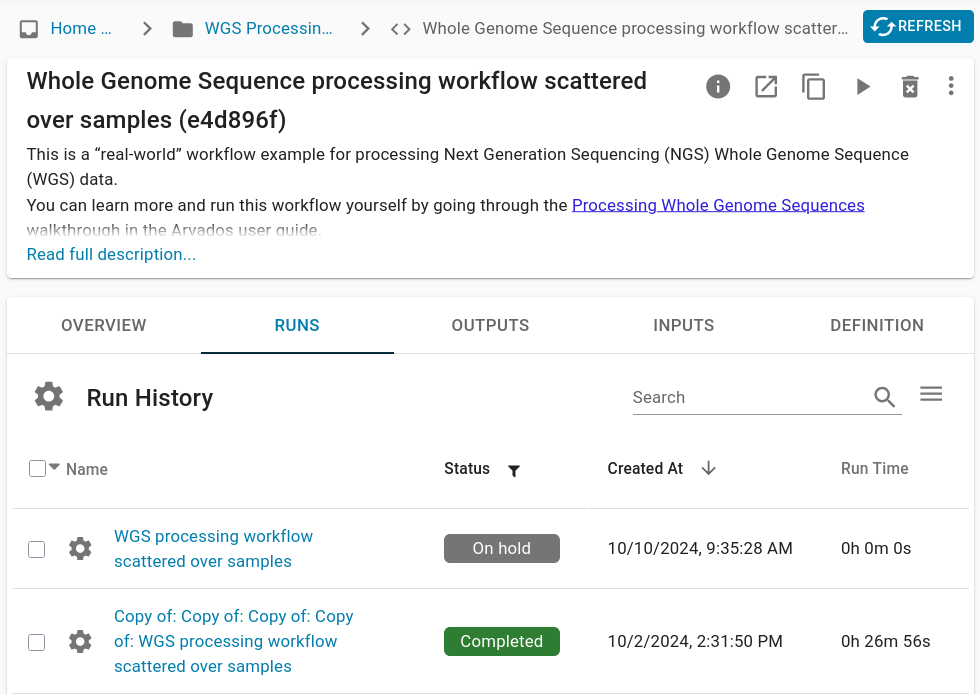
Projects, collections, and workflows can all have descriptions. A small preview of the description has been moved under the title, along with easy access to the full description for longer text. With this change, collection pages start with the Files tab open and workflow pages start with the Runs tab open. This should speed up navigation when you’re looking at familiar pages while keeping the description accessible when you’re looking at something new.
When you start a workflow with “New→Run Workflow,” Workbench correctly respects your selected “Project where the workflow will run.”
File listings use all available space.
Administrator Tools
arvados-server provides several subcommands to query and manage the cloud dispatcher. Refer to the admin documentation for full details. This is a friendly interface to the management API that has existed for a while.
The administrator API to inspect active requests includes the value of the X-Forwarded-For header.
The cluster activity workflow registers the cost spreadsheet as an output.
The cluster activity workflow stores Prometheus credentials in a file to pass CWL validation.
Fixed a crash when running the cluster activity report with a Prometheus username+password.
Fixed an erroneous cluster diagnostics error when compute nodes are outside the internal network but run a local keepstore service.
crunch-run --list does not wait to read from standard input by default.
Arvados Backend
Improved performance when a container record is reused by many (tens of thousands) of container requests.
The Crunch cloud dispatcher shuts down instances with instance types that do not appear in the cluster configuration (e.g., because that type was recently removed by an administrator).
Optimized keep-balance to use less RAM. We have seen 3.2.1 use less than half as much RAM in real large clusters.
Fixed a race condition that could cause WebDAV to refuse certain sets of concurrent collection updates with a 409 Conflict response.
Deployment
We publish packages and support installation on Red Hat Enterprise Linux (RHEL), AlmaLinux, and Rocky Linux 10.
The Packer templates to build compute nodes wait for cloud-init to finish before starting Ansible.
The compute node builder pins more NVIDIA CUDA packages to account for recent releases.
The Salt installer no longer configures the Phusion Passenger package repository. Arvados stopped requiring this in the 3.1.0 release.
The Ansible installer configures Passenger scaling options automatically based on your cluster configuration.
The Ansible installer configures nginx correctly when the cluster is configured with a single port for container web services.
The Ansible installer sets up more services on a cluster. It’s still not ready to replace the Salt installer, but getting closer:
- Keep-balance.
- Prometheus, Grafana, and related services.
- Specific PostgreSQL versions from postgresql.org.
And More
This release also includes updates for dependencies; improvements to developer tools; and work towards building new components. Check out the full release notes for more details.